No 1920 × 1080 Thumbnail: Ten Names Tried on 18 Videos, All 404
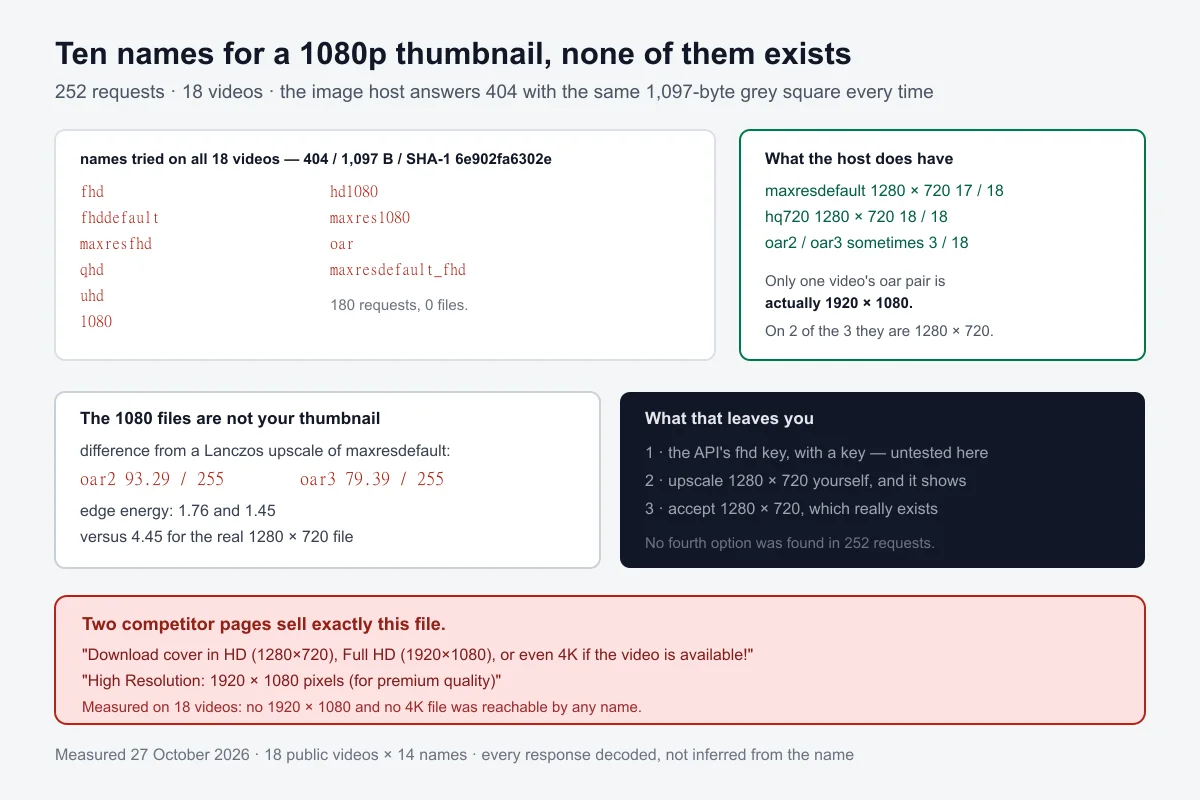
YouTube's own Data API documentation lists a 1080p thumbnail, a 1440p one and a 4K one. On 18 public videos and 252 requests made on 27 October 2026, none of those rungs could be reached on the image host under any name: the ten names aimed at them — fhd, fhddefault, maxresfhd, qhd, uhd, 1080, hd1080, maxres1080, oar, maxresdefault_fhd — came back 404 with the identical 1,097-byte placeholder on every single video, 180 requests and not one file. Two files did reach 1920 × 1080, and they are the interesting part: oar2 and oar3, which exist on 3 of the 18 videos — and on the one video where they are 1080, they are not your thumbnail. They sit 93.29 and 79.39 of 255 away from an upscale of the real thumbnail, with barely a third of its edge energy.
What the documentation promises
Quoted from snippet.thumbnails in the Data API's video resource, read on 24 October 2026:
maxres— "A high resolution version of the thumbnail image… This image is 1280px wide and 720px tall."fhd— "The full high definition (1080p) version of the thumbnail image. This image size is available for some videos. This image is 1920px wide and 1080px tall."qhd— "The quad high definition (1440p / 2K) version… 2560px wide and 1440px tall."uhd— "The ultra-high resolution (4K) version… 3840px wide and 2160px tall."
So the sizes exist as a concept, and the docs are careful twice over — "available for some videos". What the docs do not say is what to request, and that is the gap this page measured.
The ten names, on eighteen videos
No cookies, no Referer, one request per name per video, every response decoded rather than trusted. A miss on this host is not an empty body: it is a real 120 × 90 JPEG.
| Name requested | Rung it aims at | Files returned | What came back instead |
|---|---|---|---|
fhd | 1080p | 0 / 18 | 404 · 1,097 B · 6e902fa6302e |
fhddefault | 1080p | 0 / 18 | 404 · 1,097 B · same hash |
maxresfhd | 1080p | 0 / 18 | 404 · 1,097 B · same hash |
maxresdefault_fhd | 1080p | 0 / 18 | 404 · 1,097 B · same hash |
1080 | 1080p | 0 / 18 | 404 · 1,097 B · same hash |
hd1080 | 1080p | 0 / 18 | 404 · 1,097 B · same hash |
maxres1080 | 1080p | 0 / 18 | 404 · 1,097 B · same hash |
qhd | 1440p | 0 / 18 | 404 · 1,097 B · same hash |
uhd | 4K | 0 / 18 | 404 · 1,097 B · same hash |
oar | unspecified | 0 / 18 | 404 · 1,097 B · same hash |
oar2 | unspecified | 3 / 18 | 2 × 1280 × 720, 1 × 1920 × 1080 |
oar3 | unspecified | 3 / 18 | 2 × 1280 × 720, 1 × 1920 × 1080 |
maxresdefault | 720p — control | 17 / 18 | one transient 500, see below |
hq720 | 720p — control | 18 / 18 | — |
Every one of the 180 misses was the same file — one SHA-1, 1,097 bytes, 120 × 90. Not "a smaller version", not an empty response: the same grey square that tells you the name does not exist. If you were promised "Full HD" by a tool, this is what the promise resolves to on the wire.
The two files that do reach 1080 are not the thumbnail
On 3 of the 18 videos, oar2 and oar3 returned real files. Six files across three videos, and only the first video's pair measured 1920 × 1080; the other two videos returned 1280 × 720 under both names.
| Video | oar2 | oar3 | Its maxresdefault |
|---|---|---|---|
| 1 | 1920 × 1080 · 75,680 B · 3eb3aca24117 | 1920 × 1080 · 76,507 B · b00c137bdfc3 | 1280 × 720 · 65,324 B · 22b4a49df345 |
| 2 | 1280 × 720 · 16,994 B · b91c64c8ebba | 1280 × 720 · 16,994 B · b91c64c8ebba | 1280 × 720 · 184,051 B |
| 3 | 1280 × 720 · 79,711 B · 503531e66d82 | 1280 × 720 · 83,660 B · b00cd2a3e558 | 1278 × 720 · 108,323 B |
So 1080 does exist — on one video of eighteen, under a name that says nothing about resolution, and it changes shape from video to video. Now the question that matters: is the 1920 × 1080 file an actual 1080p rendering of the thumbnail? We compared each one against a Lanczos upscale of the same video's maxresdefault, and scored edge energy (the mean of a Laplacian-filtered greyscale copy), which an enlargement cannot manufacture.
| File | Difference from an upscale of the thumbnail | Edge energy | Reads as |
|---|---|---|---|
oar2 (1920 × 1080) | 93.29 of 255 | 1.76 | a different, much softer picture |
oar3 (1920 × 1080) | 79.39 of 255 | 1.45 | a different, much softer picture |
maxresdefault (1280 × 720) | — | 4.45 | the thumbnail |
upscaled maxresdefault (1920 × 1080) | — | 3.07 | what an enlargement of it looks like |
A difference of 93 on a 0–255 scale is not a re-encode of the same picture — it is a different picture. And the edge numbers run the wrong way for the "hidden high-resolution version" theory: the real 1080 file carries less fine detail than a plain upscale of the 720p one. Also worth noting: oar2 and oar3 differ from each other by 56.65, so they are not two copies of one image either.
One 500, and why it matters for a downloader
One of the 252 requests — maxresdefault on one video — answered HTTP 500 with a 1,730-byte HTML error page (text/html, "Error 500 (Server Error)!!1"). Three retries two minutes later returned 200 with 104,223 bytes, byte-identical to that video's hq720. So the failure was transient, and it was not a 404 in disguise: a tool that only branches on "did I get 200" is fine, but a tool that assumes a non-200 body is the placeholder image would have tried to decode an HTML page as a JPEG.
What the three biggest pages claim
Both competitor sitemaps in full plus vidiq's thumbnail category, scripts and styles stripped: 24 HTML files, 36,568 words.
| Term | Hits | What is there |
|---|---|---|
1920 | 14 | 12 of them are a Shorts upload spec (1080 × 1920 vertical); one is a promise of a Full HD download, one is a size table entry |
4k | 27 | all in "download in 4K if available" copy |
fhd | 0 | — |
qhd | 0 | — |
uhd | 0 | — |
upscal | 0 | — |
Two promises, quoted as written: "Download cover in HD (1280×720), Full HD (1920×1080), or even 4K if the video is available!" and "High Resolution: 1920 × 1080 pixels (for premium quality)". On the 18 videos measured here, no 1920 × 1080 and no 4K file was reachable by any name — 180 requests, zero files. The one 1080 pair that did appear is not the thumbnail. Nobody names the API's rungs, and nobody checks what the image host actually serves; the word "upscal" does not appear on any of the 24 pages.
What we did not measure
- The API itself.
fhd/qhd/uhdare keys onsnippet.thumbnails, reachable only with a key. We have no key, so we did not call it, and nothing on this page says those keys are empty — only that the image host has no such file by any name we could construct. - What
oar2/oar3depict. We can show they are a different, softer picture from the thumbnail; we cannot say which frame or what they are for. Nothing is claimed about the meaning of "oar". - How common the 1080 case is. 3 of 18 videos had any
oarfile, 1 of 18 had 1080. That is the sample; it is not a rate for all of YouTube. - Other names. Ten was our list, built from the documented keys and the
oarfamily. A name nobody thought of could exist. - Whether the 500 recurs. One occurrence in 252 requests, gone on three retries. Not enough to quote a rate.
Questions people actually ask
"Is there a 1080p YouTube thumbnail?"
Not under any name we could find on the image host: ten attempts across 18 videos, 180 requests, zero files. The API documents an fhd key — that is a different door, and it needs a key.
"A downloader offered me Full HD. What did I get?"
Check the bytes. If it is 1,097 bytes at 120 × 90 it is the placeholder and the name does not exist; if it is 1,280 × 720 it is maxresdefault. A 1920 × 1080 JPEG of a real thumbnail is not something we could obtain by name on any of the 18 videos.
"But I have seen 1920 × 1080 thumbnail files."
So have we — oar2 and oar3 on 1 of 18 videos. On that video they are a different picture from the thumbnail, and softer than an upscale of it. If yours came from a tool, compare it against maxresdefault: a real 1080 version of the same frame should differ by a few units, not ninety.
"Should I just upscale maxresdefault to 1080p myself?"
It is the only route that always works, and it is honest about what it is: an enlargement. Edge energy after upscaling measured 3.07, below the 4.45 of the original file — the detail is not there to begin with.
"What is the largest thumbnail that actually exists?"
1280 × 720, as maxresdefault (17 of 18 videos) or hq720 (18 of 18) — and the two are often byte-identical, which is measured on the maxres variants page.
Measured on 27 October 2026: 18 public videos × 14 file names = 252 HTTP requests, no cookies, no Referer, every 200 decoded to read its real pixel size and SHA-1, every non-200 inspected for status, byte count and body type. Differences are mean absolute difference per channel (0–255) against a Lanczos upscale of the same video's maxresdefault; edge energy is the mean of a Laplacian-filtered greyscale copy. No video ID, channel or thumbnail image appears on this page. Nothing here is an estimate.