Unlisted Is Not Private: An Unlisted Video's Thumbnail Comes Down Like Any Other
Every downloader FAQ we could find says the same thing in slightly different words — "only public videos". That is right about private and wrong about unlisted. We measured both on the same video ID, changing nothing but the setting in Studio. As a draft and then as private, all ten thumbnail names came back 404 with the same 1,097-byte grey placeholder — the file we measured on 24 October. Switched to unlisted, the same ten names on the same ID came back 200 with real files: 53,498 bytes at 1280 × 720 for maxresdefault, 7,963 bytes for hqdefault, 1,993 for default. Nothing about the request changed. What decides is not "is it public", it is "has a thumbnail been published for it" — and switching to unlisted publishes one.
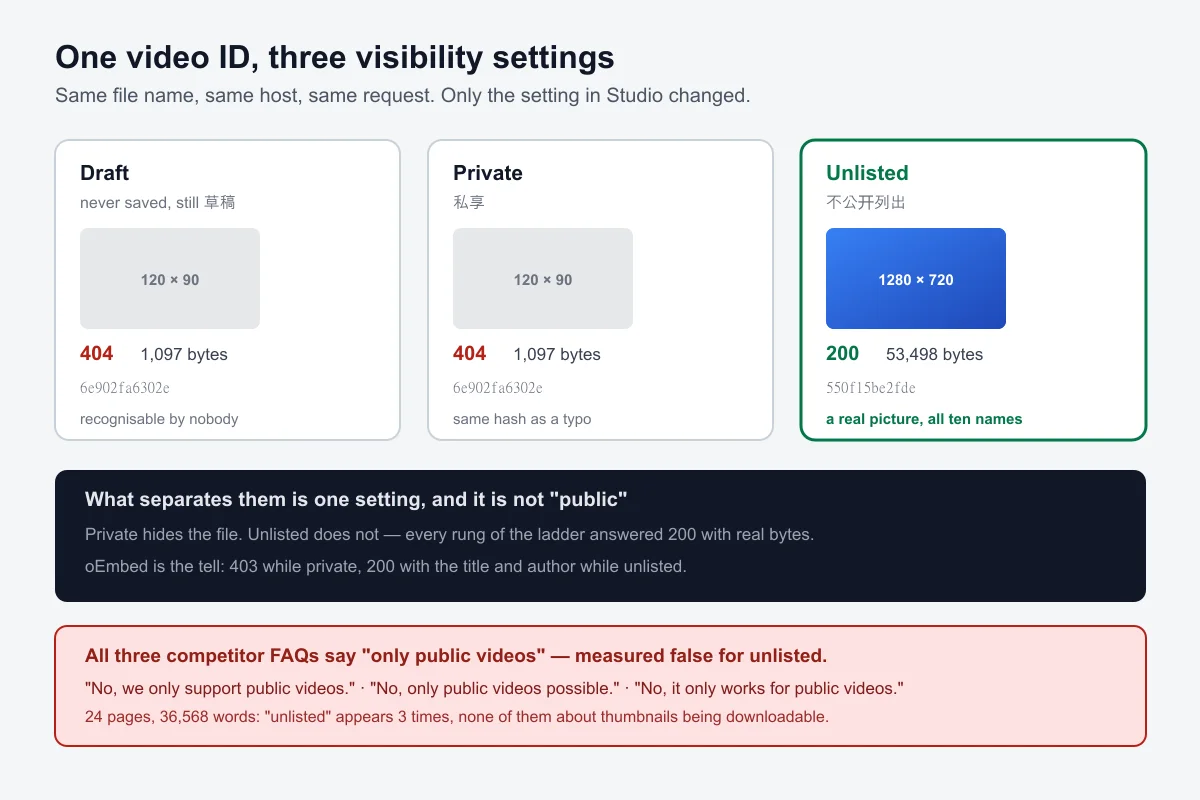
One video ID, three states
The video is a five-second 1280 × 720 upload of ours. Each row is a set of real requests to i.ytimg.com with no cookies and no Referer, made while that state was live in Studio.
| State in Studio | maxresdefault.jpg | hqdefault.jpg | oEmbed, anonymous | When measured |
|---|---|---|---|---|
| Draft (uploaded, never saved) | 404 · 1,097 B · 6e902fa6302e | 404 · 1,097 B · same hash | no data | 24 Oct 2026 |
| Private | 404 · 1,097 B · 6e902fa6302e | 404 · 1,097 B · same hash | 403 | 24 Oct 2026 |
| Unlisted | 200 · 53,498 B · 550f15be2fde | 200 · 7,963 B · 8434f763c5dc | 200, title and author returned | 26 Oct 2026 |
Two things to notice. First, the draft and the private rows are indistinguishable from each other and from a video ID that never existed — the private-video page carries that comparison. Second, the unlisted row is not a partially-open case: it is a complete, normal set of files, identical in structure to any public video's.
The whole ladder, on the unlisted video
Ten names, ten real files, every one 200. Pixels were read from each downloaded file, not assumed from the name.
| Name | Status | Bytes | Pixels | SHA-1 (first 12) |
|---|---|---|---|---|
maxresdefault.jpg | 200 | 53,498 | 1280 × 720 | 550f15be2fde |
hq720.jpg | 200 | 53,498 | 1280 × 720 | 550f15be2fde |
maxres1.jpg | 200 | 48,814 | 1280 × 720 | c2a71f375644 |
maxres2.jpg | 200 | 48,814 | 1280 × 720 | c2a71f375644 |
maxres3.jpg | 200 | 48,814 | 1280 × 720 | c2a71f375644 |
sddefault.jpg | 200 | 23,512 | 640 × 480 | 798356bd5bee |
hqdefault.jpg | 200 | 7,963 | 480 × 360 | 8434f763c5dc |
mqdefault.jpg | 200 | 4,729 | 320 × 180 | d84701a930e1 |
default.jpg | 200 | 1,993 | 120 × 90 | bf262f2d22a9 |
/vi_webp/…/maxresdefault.webp | 200 | 20,688 | 1280 × 720 | WebP container |
One detail worth keeping, because it contradicts a habit: here maxres1, maxres2 and maxres3 are the same file (one hash, 48,814 bytes each) while maxresdefault and hq720 are a different file at 53,498. On the day we measured 12 public videos, the numbered names were usually three different pictures. So the numbered names cannot be treated as three variations by default — sometimes they are one picture written three times.
What actually changed under the request
Nothing in the URL, the headers or the host. The only difference between the private run and the unlisted run is a setting on the video. That tells you where the gate is: not on the image host, and not on the downloader. A tool asking i.ytimg.com for a name either gets a file or the placeholder, and the placeholder says nothing about why.
The one place where the state is visible is oEmbed. For the same ID:
| State | oEmbed status | Body |
|---|---|---|
| Private | 403 | refused |
| Unlisted | 200 | title, author_name, thumbnail_url = hqdefault.jpg, thumbnail_width 480, thumbnail_height 360 |
So if you need to know whether a video is merely unlisted or actually private, do not ask the image host — ask oEmbed. A 200 there plus a 404 on the image host would be a strange combination; in our two runs the two always agreed.
The part that matters for your own uploads
Unlisted is the setting people use when they want a video reachable by link but not listed — a review copy, an embed for one client, a test render. If you also treat it as "the thumbnail is not out yet", that assumption does not hold: the moment the video is unlisted, all ten thumbnail files are publicly readable by anyone who has the eleven-character ID, with no cookies and no referrer.
- Embargoing the picture is not what unlisted does. It hides the video from search and from your channel's listings. It does not withhold the thumbnail file.
- If the picture must not be seen before a date, the state that withholds it is private — measured above, 404 and 1,097 bytes on every name.
- Whatever you do, the moment the state flips to unlisted, treat the thumbnail as published, because that is what the server does.
What the three biggest pages say
Both competitor sitemaps in full plus vidiq's thumbnail category, scripts and styles stripped: 24 HTML files, 36,568 words.
| Term | Hits | What is there |
|---|---|---|
only public | 1 | "No, only public videos possible." |
only works for public | 1 | "No, it only works for public videos." |
public videos | 4 | the same three FAQs plus one line of design advice |
private | 7 | three FAQs; four mentions inside vidiq's A/B-testing article as an excluded category |
unlisted | 3 | two in vidiq's A/B article ("the official Help page excludes private videos but does not clarify unlisted status"), one in a testing workaround on youtubethumbnaildownloader.com — none about whether the thumbnail is downloadable |
Quoted as written, the three answers are: "Can you download thumbnails from private videos? No, we only support public videos." · "Can I get thumbnail of private videos? No, only public videos possible." · "Is it possible to getting a Thumbnail preview of private videos? No, it only works for public videos." All three are answering about private, and all three are correct about private. But each is phrased as a rule about visibility in general, and that phrasing is what fails on unlisted — where we measured ten out of ten files served. Twenty-four pages, and the word "unlisted" appears three times, never once asking whether the picture comes down.
What we did not measure
- One video, one channel. This is a single five-second upload of ours, switched between states on two days. A second video, or another channel's unlisted video, was not tested.
- Scheduled and premiere states. A scheduled video has a date in the future; we did not test whether its thumbnail is served before that date. Given the result above, that is the obvious next question and it is not answered by this page.
- Members-only and age-restricted. Untested.
- Whether the files are byte-identical across the flip. We know the private state had no file and the unlisted state has one; we cannot say whether the published file was generated at upload, at the moment of the flip, or earlier — only that it did not exist for us before the flip.
- Whether unlisted files are cached differently. Cache behaviour was measured on public files only, on its own page.
Questions people actually ask
"Can I download the thumbnail of an unlisted video?"
Yes. Measured on our own unlisted video: ten file names, all 200, the largest 53,498 bytes at 1280 × 720. No cookies, no referrer, no login.
"Then why do downloaders say only public videos?"
Because private and unlisted get lumped together under "not public". They behave completely differently at the image host, and the difference is measurable in one request.
"Is an unlisted video's thumbnail private in any sense?"
No. The file is served to anyone who knows the ID. Unlisted hides the video from search and from your channel page; it does not withhold the picture.
"How do I tell an unlisted video from a private one?"
Use oEmbed: 200 with a title means unlisted (or public); 403 means private. The image host cannot tell you, because both the "no file" cases look identical there.
"Does this mean I can fetch the thumbnail before I publish?"
Not from private, and not from a draft — both give 404. It becomes fetchable when the video is unlisted. Scheduling is a separate state we did not measure.
Measured on 24 and 26 October 2026 on one five-second 1280 × 720 video of our own, 9jEIbfAUtSw, which we switched from draft to private to unlisted. Every number above comes from an HTTP request with no cookies and no Referer, or from decoding the returned file to read its pixel size and SHA-1. The competitor counts are from the same day's copies of both sitemaps and vidiq's category page — all three byte-identical to the previous day. We name no other channel and show no thumbnail image. Nothing here is an estimate.