YouTube Thumbnail 480 × 360 Is Really 480 × 270: Black Bars Inside hqdefault and sddefault
Ask any downloader for hqdefault.jpg and it will tell you the file is 480 × 360. That is the canvas size, not the picture. On 13 public videos measured on 25 October 2026 — six file names each, 78 requests, every one answering 200 — the hqdefault file arrived with 45 rows of pure black at the top and 45 at the bottom, leaving 480 × 270 of actual picture. sddefault.jpg did the same at 640 × 480 → 640 × 360, and default.jpg at 120 × 90 → 120 × 68. The three names that come back clean are mqdefault, maxresdefault and hq720. This is a property of the file, not of the video: all 13 videos did it, and the bar is always exactly 12.5% of the canvas height on each side.
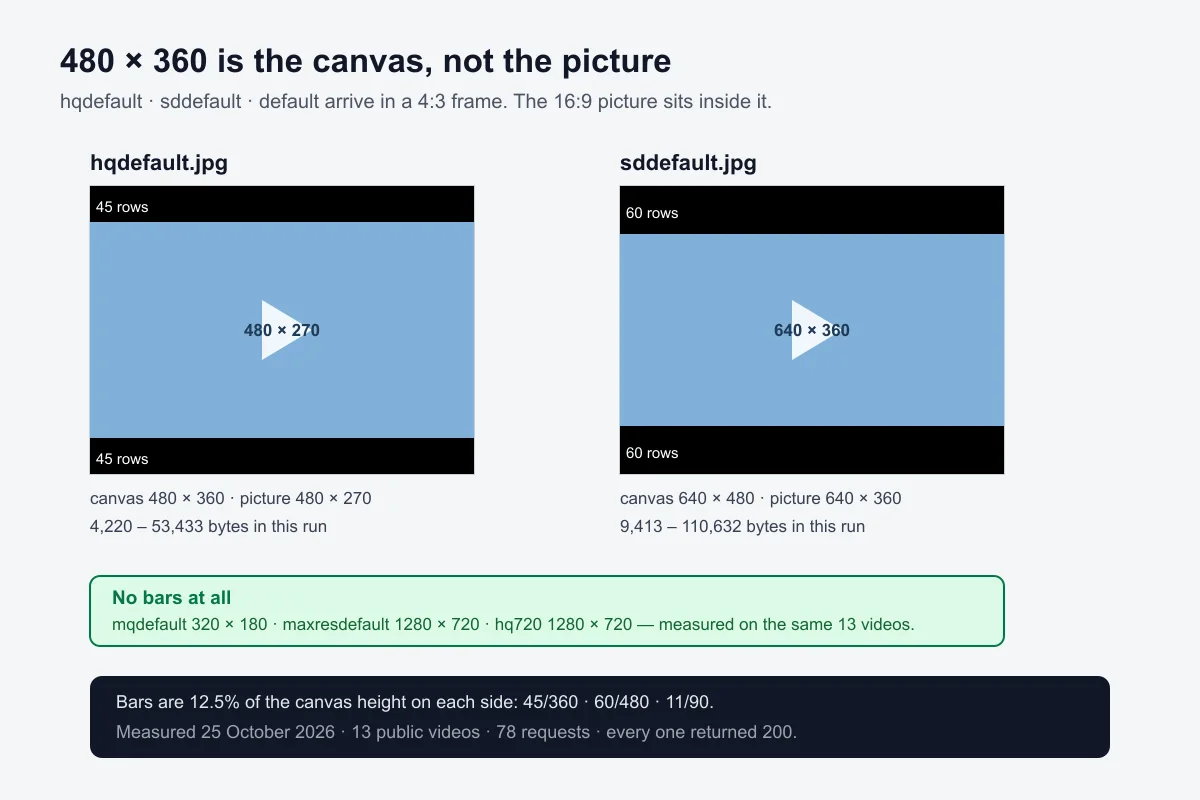
What each name actually contains
Thirteen public videos, six names, nothing filtered. Bar height is measured as the run of rows at the very top and very bottom whose average brightness is below 8 of 255.
| Name | Canvas | Black rows, top / bottom | Picture you can use | Bytes in this run | Bars present |
|---|---|---|---|---|---|
maxresdefault.jpg | 1280 × 720 | 0 / 0 | 1280 × 720 | 19,447 – 334,114 | no |
hq720.jpg | 1280 × 720 | 0 / 0 | 1280 × 720 | 19,447 – 334,114 | no |
sddefault.jpg | 640 × 480 | 60 / 60 (59 on one video) | 640 × 360 | 9,413 – 110,632 | yes |
hqdefault.jpg | 480 × 360 | 45 / 45 (44 on two videos) | 480 × 270 | 4,220 – 53,433 | yes |
mqdefault.jpg | 320 × 180 | 0 / 0 | 320 × 180 | 1,892 – 26,633 | no |
default.jpg | 120 × 90 | 11 / 11 (10–12) | 120 × 68 | 1,305 – 5,096 | yes |
Read the fourth column against the second. Only three names give you a picture at the size the canvas advertises. For the other three, the useful height is a quarter less than the height in the file name's reputation — and if your code assumes 480 × 360, a 16:9 image pasted into that box is either stretched vertically or gets its own bars added on top of the ones already there.
The arithmetic is fixed, so you can predict it
Every bar measured came out at one eighth of the canvas height, top and bottom:
| Canvas height | Bar per side | As a fraction | Picture height | Picture aspect |
|---|---|---|---|---|
| 360 | 45 | 12.5% | 270 | 480 : 270 = 16 : 9 |
| 480 | 60 | 12.5% | 360 | 640 : 360 = 16 : 9 |
| 90 | 11 | 12.2% (11.25 rounded) | 68 | 120 : 68 ≈ 16 : 9 |
So the rule is: a 4:3 canvas holding a 16:9 picture must waste h × 0.125 at the top and the same at the bottom. Crop those two bands off and what remains is exactly 16:9. Nothing about the video changes this — the three videos whose hqdefault came back with 44 rather than 45 rows are off by one row, which is what you would expect from rounding on a 270.0-row picture.
Is the black really black?
Yes, to within JPEG noise. For each video we took the whole top band of hqdefault — 480 × 45 = 21,600 pixels — and looked at the pixel values.
| Video | Exactly (0,0,0) | Share | Mean brightness | Brightest channel value seen |
|---|---|---|---|---|
| 1 | 16,680 | 77.2% | 0.29 | 18 |
| 2 | 16,768 | 77.6% | 0.34 | 28 |
| 3 | 15,971 | 73.9% | 0.39 | 28 |
| 4 | 16,398 | 75.9% | 0.26 | 13 |
| 5 | 18,292 | 84.7% | 0.36 | 31 |
| 6 | 20,160 | 93.3% | 0.11 | 2 |
| 7 | 15,079 | 69.8% | 0.64 | 19 |
| 8 | 15,664 | 72.5% | 0.55 | 31 |
| 9 | 15,117 | 70.0% | 0.84 | 54 |
| 10 | 16,312 | 75.5% | 0.48 | 49 |
| 11 | 17,945 | 83.1% | 0.26 | 24 |
| 12 | 15,154 | 70.2% | 0.63 | 17 |
| 13 | 16,886 | 78.2% | 0.18 | 8 |
Between 69.8% and 93.3% of those pixels are exactly zero, and the whole band averages under 1 of 255 — the non-zero values are the ringing a JPEG encoder leaves around a hard edge. Practically: a bar-detection test can use a plain brightness threshold, and a bar-removal crop can be hard-coded without looking at pixels.
What to do with this
- If you need 16:9, ask for a 16:9 name.
mqdefault(320 × 180),maxresdefault(1280 × 720) andhq720(1280 × 720) have no bars.hqdefaultis not a 16:9 file at all. - If
hqdefaultis all that exists, crop 45 rows off the top and 45 off the bottom. You end up with 480 × 270, which is still more picture thanmqdefault's 320 × 180 — about 1.5× on each side. - Do not paste
hqdefaultinto a 16:9 box as-is. The canvas is 4:3, so a player or a CSS box with a 16:9 ratio will either stretch it (faces get 33% taller) or add a second pair of bars outside the first pair. - Use the byte count, not the pixel count, to tell a real file from a placeholder. A miss is 1,097 bytes at 120 × 90; a real
default.jpgis also 120 × 90 and weighs 1,305–5,096 bytes. The size test is on its own page. - Expect the same 4:3 frame on
sddefault. It is not a 640 × 480 picture; it is 640 × 360 of picture in a 640 × 480 wrapper, which is why it is only about 2× the bytes ofhqdefaultdespite twice the pixel count.
What the three biggest thumbnail pages say about this
Both competitor sitemaps in full, plus vidiq's thumbnail category, stripped of scripts and styles: 24 HTML files, 36,568 words.
| Term | Hits | What they are |
|---|---|---|
4:3 | 0 | — |
pillarbox | 0 | — |
480x360 / 480 x 360 | 0 | — |
640x480 / 640 x 480 | 0 | — |
letterbox | 1 | vidiq, about a 16:9 thumbnail repurposed into a 9:16 Shorts slot |
black bar | 2 | vidiq's Shorts page, twice, same point: a 1280 × 720 thumbnail "will display with black bars … in vertical placements" |
16:9 | 37 | all about the upload requirement, never about a served file |
aspect ratio | 35 | same |
The three mentions that exist are about the creator's own thumbnail being shown badly in a vertical slot — a display problem on YouTube's side. None of them is about a file you download arriving with bars baked into it, and none of the 24 pages names hqdefault or sddefault as a 4:3 file. This is the same asymmetry as the rest of this site: they write about what to upload, we measure what comes back.
What we did not measure
- Whether the 480 × 270 picture is a fresh render or an enlargement of the 320 × 180 one — resolved the next day. The round-trip test we ran here could not separate the cases. A better test can: build both candidates from the 1280 × 720 original and see which one the real file matches. It matches the genuine rendering on 12 of 13 videos. The numbers are on the real-or-upscaled page; this paragraph is left in place so the two pages do not contradict each other.
- Vertical source videos. All 13 videos here are 16:9 uploads. A Shorts-style upload would presumably get side bars instead of top and bottom ones, or a cropped picture; we did not test it, and the Shorts page covers a different question.
- Thumbnails uploaded at 4:3. YouTube accepts other aspect ratios on upload; we did not test what a 4:3 source thumbnail produces at these names.
- Whether this has always been the case. One measurement day, no history.
- Videos whose
hqdefaulthas a different picture entirely. We compared only sizes and bars, not whether the three names show the same frame — the variants page covers the 1280 × 720 names, which do differ in content.
Questions people actually ask
"I downloaded hqdefault and it has black bars top and bottom. Is the download broken?"
No. That is the file YouTube serves. The frame is 480 × 360 (4:3) and the picture inside it is 480 × 270 (16:9); the bars are part of the JPEG, not added by your browser or your downloader.
"Which name gives me 480 × 360 of actual picture?"
None of them. mqdefault is 320 × 180 of picture with no bars, hqdefault is 480 × 270 of picture inside a 480 × 360 frame, and the next clean step up is maxresdefault / hq720 at 1280 × 720.
"Why is the file 480 × 360 then?"
Because that is the canvas YouTube renders those three names on — a legacy 4:3 box, at a time when thumbnails were described as 480 × 360. The picture is fitted into it and the leftover is filled with black.
"Does cropping the bars lose quality?"
No pixels are resampled by a crop; you simply discard the two bands. The result is a 480 × 270 image, byte-for-byte the same pixels that were in the middle of the original.
"Is sddefault better than hqdefault?"
It is bigger: 640 × 360 of picture rather than 480 × 270, at roughly twice the bytes. Both carry the same 12.5% bars, so if you are cropping, both crop to 16:9.
Everything above was measured on 25 October 2026: 13 public videos × 6 file names = 78 requests, all 200, every file decoded offline for its pixel size and scanned row by row for black bands. Bar rows were counted with a brightness threshold of 8 of 255; the share of exactly-zero pixels and the brightest channel value in the top band are given in the table rather than summarised. No video ID, channel or thumbnail image is shown on this page. The competitor counts come from the same day's copies of both sitemaps and vidiq's category page — all three byte-identical to the previous day. Nothing here is an estimate.